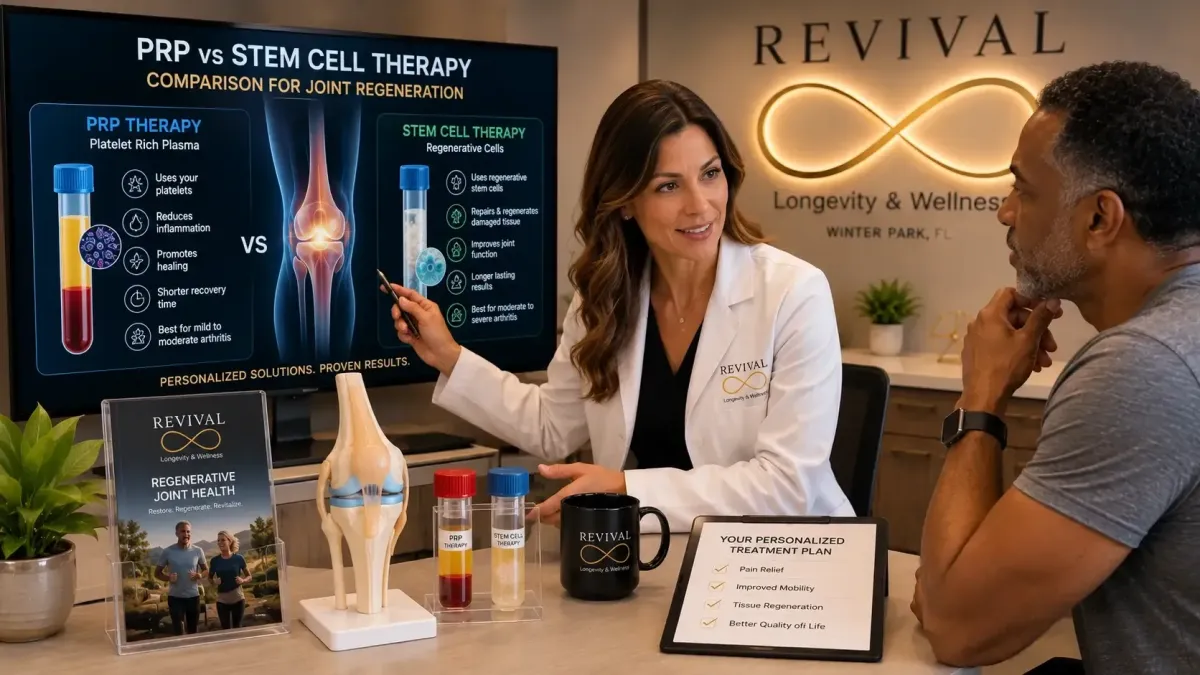
PRP vs Stem Cell Therapy in Winter Park: Which Is Right for You?
The Winter Park executive facing chronic shoulder pain from years of tennis stands at a crossroads familiar to many successful professionals: accept progressive limitations on the activities he loves, undergo invasive surgery with months of recovery, or explore the promising but complex world of regenerative medicine. With both PRP and stem cell therapy offering hope for joint repair, understanding the differences becomes crucial for making the best treatment decision.
At Revival Longevity & Wellness in Winter Park, we regularly help professionals navigate this decision by providing comprehensive comparisons of regenerative treatment options based on their specific conditions, goals, and lifestyle demands.
Both platelet-rich plasma (PRP) and stem cell therapy represent significant advances in regenerative medicine, but they work through different mechanisms and are optimal for different types of joint problems. Understanding these differences—along with the current research evidence—enables informed decision-making about which approach offers the best potential for your specific situation.
Recent clinical research published in PMC demonstrates that both PRP and stem cell therapies show promise for various joint conditions, but their effectiveness varies depending on the specific condition, severity, and patient factors: https://pmc.ncbi.nlm.nih.gov/articles/PMC10298392/
For Winter Park professionals who demand evidence-based treatment recommendations and want to understand their options thoroughly before committing to any regenerative approach, a detailed comparison of PRP and stem cell therapy provides the foundation for optimal treatment selection.
Understanding PRP Therapy: Concentrated Healing Power
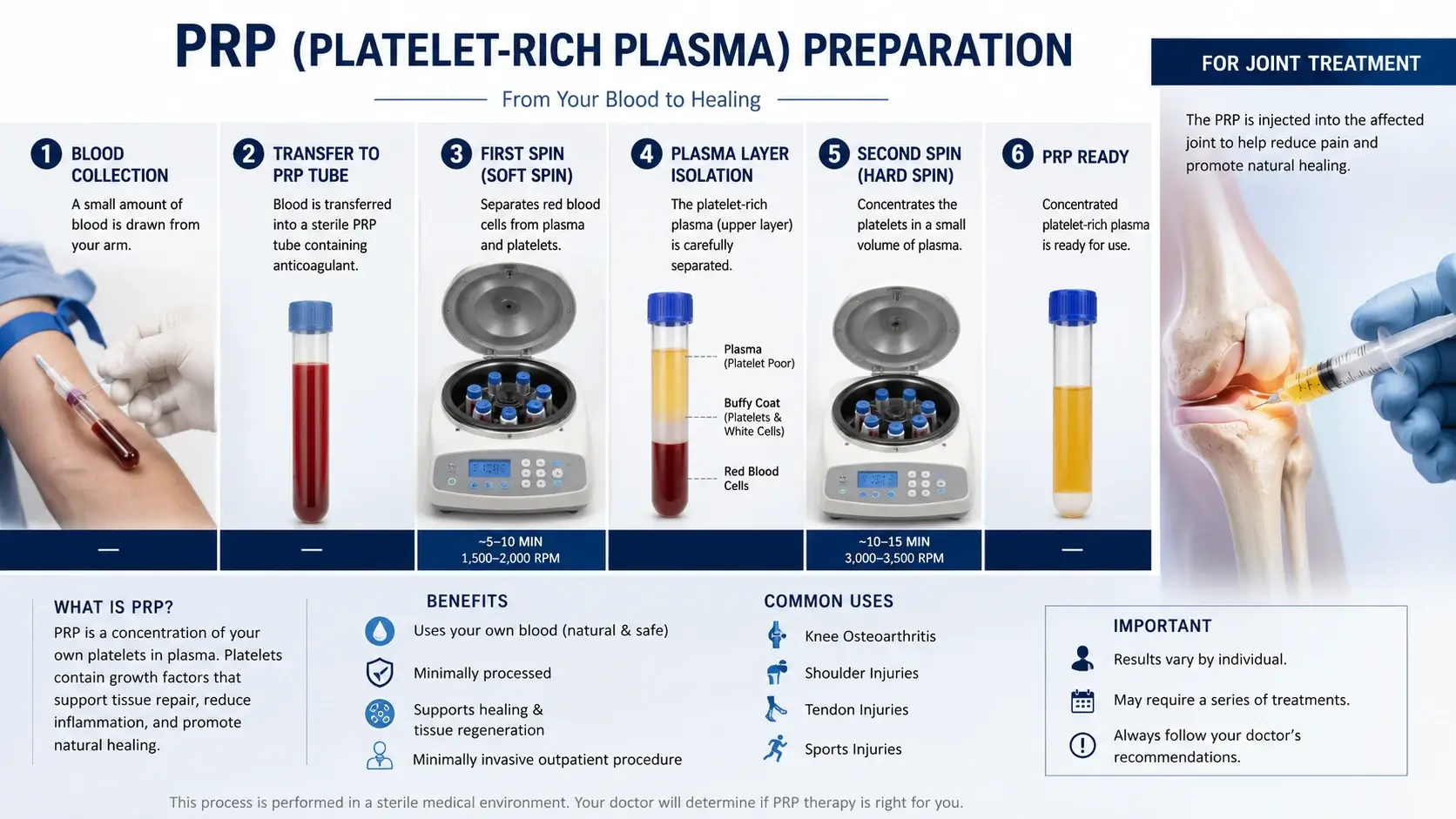
Platelet-rich plasma therapy harnesses your body's natural healing mechanisms by concentrating the platelets and growth factors from your own blood and delivering them directly to damaged joint tissues. This approach amplifies your body's existing repair processes rather than introducing external cellular elements.
The PRP process begins with drawing a small amount of your blood—typically 30-60 milliliters—which is then processed in a centrifuge to separate and concentrate the platelets. The resulting PRP contains platelet concentrations 3-7 times higher than normal blood, along with concentrated growth factors and bioactive proteins.
Growth factors in PRP include platelet-derived growth factor (PDGF), transforming growth factor-beta (TGF-β), vascular endothelial growth factor (VEGF), insulin-like growth factor (IGF-1), and numerous others that stimulate tissue repair, reduce inflammation, and promote healthy tissue formation.
The mechanism of action involves direct delivery of these concentrated healing factors to damaged tissues, where they stimulate cellular proliferation, enhance collagen synthesis, promote angiogenesis (new blood vessel formation), and create an optimal environment for natural tissue repair.
PRP therapy is particularly effective for tendon injuries, ligament damage, early-stage arthritis, and soft tissue problems where the tissue structure is largely intact but healing is impaired or incomplete. The concentrated growth factors can jump-start stalled healing processes and promote more complete tissue repair.
For Winter Park professionals, PRP offers several practical advantages. The procedure can be completed in under an hour during a lunch break, requires minimal recovery time with most patients returning to work the same day, and uses only your own blood components, eliminating concerns about foreign substances or immune reactions.
Clinical applications where PRP shows particular promise include tennis elbow and other tendon problems, early-stage knee or hip arthritis, shoulder impingement and rotator cuff injuries, chronic ligament injuries, and muscle strains that haven't healed completely.
The treatment timeline for PRP typically involves an initial injection followed by assessment at 4-6 weeks to determine if additional treatments are needed. Many conditions respond well to 1-3 PRP treatments spaced several weeks apart.
Understanding Stem Cell Therapy: Regenerative Potential
Stem cell therapy represents a more advanced regenerative approach that introduces multipotent cells capable of differentiating into various tissue types while also secreting powerful healing factors. This dual mechanism offers both direct tissue replacement and enhanced healing environment creation.
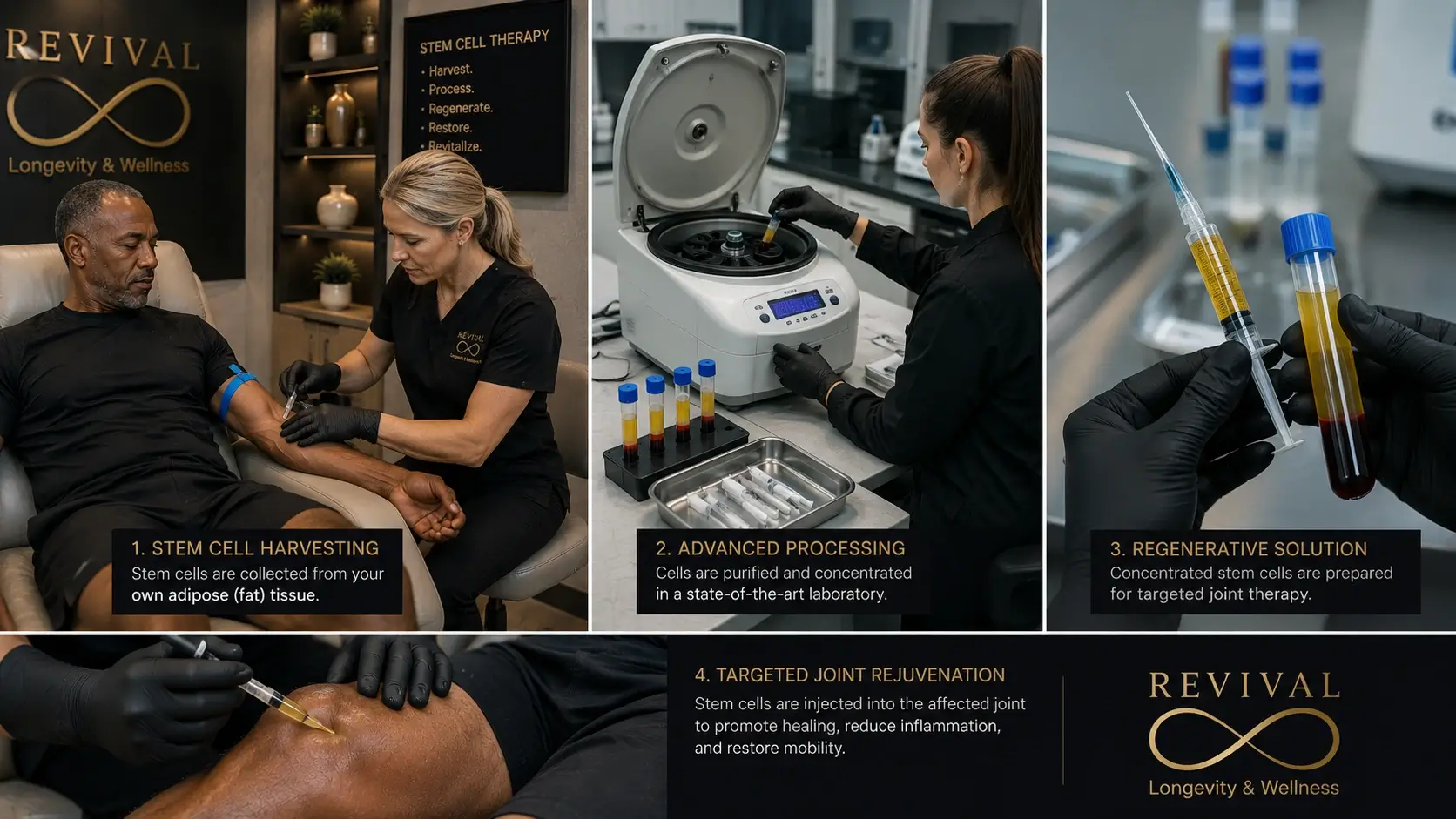
Mesenchymal stem cells (MSCs) used in joint therapy are typically harvested from your own adipose (fat) tissue or bone marrow through minimally invasive procedures. These autologous stem cells ensure perfect compatibility while providing remarkable regenerative potential.
The differentiation capacity of MSCs allows them to become chondrocytes (cartilage cells), osteoblasts (bone cells), tenocytes (tendon cells), and other joint tissues as needed for repair. This versatility makes stem cell therapy particularly valuable for conditions involving actual tissue loss or damage.
Beyond direct tissue replacement, stem cells secrete a complex array of growth factors, cytokines, and other bioactive molecules that create powerful regenerative microenvironments. These paracrine effects may actually be more important than direct cellular replacement in many therapeutic applications.
Research published in PMC reveals that mesenchymal stem cells demonstrate remarkable ability to create repair microenvironments that reduce pain and halt disease progression, with transplanted cells expressing genes that enhance collagen synthesis and produce anti-inflammatory proteins: https://pmc.ncbi.nlm.nih.gov/articles/PMC8445610/
Stem cell therapy is particularly suited for more advanced joint damage where significant tissue replacement is needed, including moderate to severe arthritis with cartilage loss, large tendon tears or chronic tendon degeneration, osteonecrosis (bone tissue death), complex joint injuries involving multiple tissue types, and conditions where PRP or conventional treatments haven't provided adequate improvement.
The stem cell procedure is more complex than PRP, typically requiring harvesting of stem cells from fat tissue (usually from the abdomen or flanks) or bone marrow, processing and concentrating the cells in specialized laboratory equipment, and injection under imaging guidance for precise placement.
Recovery from stem cell therapy may involve several days of reduced activity, particularly if fat harvesting was required, though most professionals can return to desk work within a few days. The regenerative effects develop more gradually, often taking 3-6 months to reach maximum benefit.
Comparative Effectiveness: What the Research Shows
Understanding the comparative effectiveness of PRP versus stem cell therapy requires examining the current research evidence, which continues to evolve as more clinical trials are completed and longer-term follow-up data becomes available.
For knee osteoarthritis, which represents the most extensively studied application, both treatments show promise but with different strengths. PRP appears particularly effective for early-stage arthritis and may provide benefits that last 6-12 months or longer. Stem cell therapy may offer advantages for more advanced arthritis and potentially longer-lasting improvements.
The landmark MILES study, conducted at Duke University and other major medical centers, compared different types of stem cell therapy with corticosteroid injections in 480 patients with knee osteoarthritis. While stem cell therapy didn't prove superior to steroid injections at one year, the study provided valuable insights into patient selection and treatment protocols.
Research published in the global clinical trial landscape analysis demonstrates that the number of stem cell-based clinical trials for osteoarthritis is increasing globally, with most studies focusing on knee osteoarthritis using intra-articular administration and showing potential benefits for pain and function: https://www.ncbi.nlm.nih.gov/pmc/articles/PMC12913396/
For tendon injuries, PRP has more extensive research support and appears to be highly effective for many common tendon problems like tennis elbow, Achilles tendinitis, and patellar tendinitis. Stem cell therapy for tendon injuries shows promise but has less clinical data supporting its use.
Cost-effectiveness considerations also factor into treatment selection. PRP therapy typically costs less than stem cell therapy and may provide excellent results for appropriate conditions, making it an attractive first-line option for many joint problems.
Treatment durability varies between approaches and conditions. PRP effects typically last 6-18 months, while stem cell therapy may provide benefits lasting 2-5 years or longer in some patients. However, individual responses vary significantly.
Safety profiles for both treatments are excellent when performed by qualified providers. PRP carries minimal risk since it uses only your own blood components. Stem cell therapy has slightly higher complexity but maintains excellent safety when proper protocols are followed.
Patient Selection: Matching Treatment to Individual Needs
Optimal outcomes from regenerative therapy depend heavily on matching the right treatment approach to individual patient factors, condition characteristics, and treatment goals. At Revival Longevity & Wellness, comprehensive evaluation guides treatment selection for Winter Park professionals.
Condition severity represents one of the most important factors in treatment selection. Early-stage arthritis, minor tendon injuries, and conditions with relatively intact tissue structure often respond excellently to PRP therapy. More advanced joint damage with significant tissue loss may benefit more from stem cell therapy's regenerative potential.
Age and overall health status influence both treatment selection and expected outcomes. Younger patients with good overall health may respond well to either approach, while older patients or those with multiple health conditions may need more individualized treatment selection.
Activity level and functional goals help determine which treatment approach aligns best with desired outcomes. The competitive athlete seeking to return to high-level performance may benefit from stem cell therapy's potentially longer-lasting effects, while the recreational athlete may achieve excellent results with PRP.
Previous treatment history provides valuable information for regenerative therapy selection. Patients who haven't responded adequately to physical therapy, medications, or previous injection treatments may be better candidates for stem cell therapy's more powerful regenerative approach.
Timeline considerations affect treatment choice for busy professionals. Those needing rapid return to activities may prefer PRP's faster recovery, while those able to accommodate longer recovery may benefit from stem cell therapy's potentially more comprehensive tissue repair.
Economic factors, including insurance coverage and out-of-pocket costs, often influence treatment decisions. Understanding the cost-benefit ratio for each approach helps guide selection based on individual circumstances.
For comprehensive evaluation and personalized treatment recommendations, Winter Park professionals can explore our joint restoration services at revivallongevitywellness.com/services/joint-restoration.
Combination Approaches and Treatment Protocols
Some of the most successful regenerative medicine outcomes result from strategic combination of different approaches rather than relying on any single treatment. Understanding how PRP and stem cell therapy can be combined or sequenced provides additional options for optimal joint health restoration.
Sequential treatment protocols might begin with PRP therapy for its faster recovery and lower complexity, followed by stem cell therapy if additional improvement is needed. This approach allows patients to experience regenerative benefits quickly while preserving the option for more advanced treatment.
Combination therapy protocols deliver both PRP and stem cell therapy simultaneously, potentially providing immediate growth factor stimulation from PRP along with longer-term regenerative potential from stem cells. Some providers mix PRP with stem cells during the injection procedure.
Maintenance protocols might use PRP treatments periodically to maintain and enhance the benefits of initial stem cell therapy. This approach could provide sustained regenerative benefits while minimizing the need for repeated stem cell procedures.
Integrated treatment programs combine regenerative therapies with complementary approaches like targeted nutrition, strategic rehabilitation, and lifestyle optimization to maximize outcomes. This comprehensive approach addresses all factors that influence healing and long-term joint health.
Treatment timing and scheduling can be optimized for busy professional schedules. Some protocols allow for treatments to be spaced around important work commitments, travel schedules, or seasonal activity patterns.
For Winter Park professionals seeking comprehensive regenerative medicine approaches, our complete services overview is available at revivallongevitywellness.com/services.
Making Your Treatment Decision
Choosing between PRP and stem cell therapy—or determining if combination approaches are optimal—requires careful consideration of multiple factors along with expert medical guidance based on current research evidence and clinical experience.
Comprehensive evaluation provides the foundation for informed treatment decisions. This includes detailed assessment of your condition severity and characteristics, overall health status and healing capacity, activity level and functional goals, previous treatment responses, timeline preferences and constraints, and economic considerations.
Evidence-based recommendations consider the current research supporting different approaches for your specific condition, along with realistic expectations for improvement and treatment durability.
Personalized treatment planning takes into account your individual circumstances, preferences, and goals to develop the approach most likely to provide meaningful improvement for your situation.
Ongoing monitoring and potential treatment adjustments ensure that your regenerative therapy continues to provide optimal benefits and address any evolving needs or goals.
For Winter Park professionals ready to explore regenerative medicine options and receive personalized treatment recommendations, comprehensive consultation is available at revivallongevitywellness.com/consultation.
The decision between PRP and stem cell therapy doesn't need to be permanent or exclusive. Many patients benefit from starting with one approach and adding or transitioning to another based on their response and evolving needs.
Frequently Asked Questions
What's the difference between PRP and stem cell therapy?
PRP (Platelet-Rich Plasma) uses concentrated growth factors from your own blood to stimulate healing, while stem cell therapy uses cells capable of developing into various tissue types for regeneration. Both promote healing but through different mechanisms.
Which is better for joint pain — PRP or stem cell therapy?
The choice between PRP and stem cell therapy depends on your specific condition, severity of damage, and treatment goals. PRP often works well for mild to moderate joint issues, while stem cell therapy may be more appropriate for severe damage or poor healing response.
How much does PRP cost compared to stem cell therapy?
PRP therapy typically costs less than stem cell therapy due to simpler processing requirements. However, some conditions may require multiple PRP sessions, while stem cell therapy might provide longer-lasting results with fewer treatments.
Are PRP and stem cell therapies covered by insurance?
Most regenerative therapies including PRP and stem cell treatments are not covered by traditional insurance plans as they're considered investigational. We provide detailed documentation for flexible spending accounts where applicable.
Can PRP and stem cell therapy be combined?
Yes, PRP and stem cell therapy can often be combined for enhanced results. The growth factors in PRP can support stem cell survival and function, potentially providing superior outcomes compared to either treatment alone.
What conditions respond best to each treatment?
PRP often works well for tendon injuries, mild arthritis, and acute injuries. Stem cell therapy may be more effective for severe arthritis, cartilage damage, and conditions requiring significant tissue regeneration.
How do I know which treatment is right for me?
The choice between PRP and stem cell therapy requires comprehensive evaluation of your condition, medical history, goals, and other factors. We provide detailed consultation to recommend the most appropriate treatment option for your specific needs.
Ready to discover which regenerative approach is optimal for your joint health needs? Contact Revival Longevity & Wellness to schedule your comprehensive evaluation and learn about the PRP and stem cell therapy options that can help restore your joint function and comfort.
For comprehensive information about regenerative joint health and how these treatments fit into complete wellness optimization, read our complete guide at revivallongevitywellness.com/post/stem-cell-therapy-joint-pain-winter-park
